

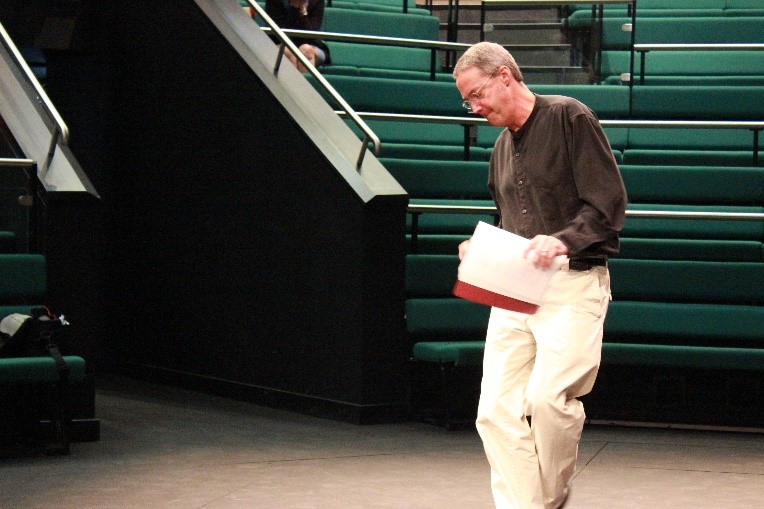
Goffman (1959) taught us how we could understand organizations as theatre. In his academic work Steve Taylor has been more interested in how plays are used within organizations (e.g. Nissley, Taylor, & Houden, 2004; Steven S. Taylor, 2000, 2003, 2008) as an example of a much larger movement of the use of arts-based methods within organizations (cf Steven S. Taylor & Ladkin, 2009). Alongside his academic work, Steve have written plays as a different way of thinking – even theorizing (Steven S. Taylor, 2000) – about organizations. Believing that artistic understanding embraces its inherent subjectivity and is well suited for making meaning in complex phenomena such as organizations.
Steve has debuted a play at AoMO conferences since 2002 and this year is no different! Saturday September 3rd 2016 sees the inaugural performance of The Age of Loneliness. In The Age of Loneliness, June, a young playwright struggles with what comes after her success with her play, The Adventures of Yahweh and Kapital (seen previously in, The Invisible Foot). Can Yahweh and Kapital get along, what sort of relationship will they have, can they survive in a post-growth world, should she even keep writing the play? If this truly is the end of the neo-liberal consensus, what comes next? Can an omnipotent, immortal die?
Steve Taylor’s Play at the Art of Management and Organization Conferences
The Age of Loneliness. 2016. Bled, Slovenia.
Through the Reading Glasses. 2014. Copenhagen, Denmark.
The Invisible Foot. 2012. York, England.
Cow Going Abstract. 2008. Banff, Canada.
Blasphemy & Doubt. 2006. Krakow, Poland.
Ties That Bind. 2004. Paris, France.
Soft Targets. 2002. London, England.
References
Goffman, Erving. (1959). The presentation of self in everyday life. New York: Doubleday.
Nissley, Nick, Taylor, Steven S., & Houden, Linda. (2004). The politics of performance in organizational theatre-based training and interventions. Organization Studies, 25(5), 817-840.
Taylor, Steven S. (2000). Aesthetic knowledge in academia: Capitalist pigs at the academy of management. Journal of Management Inquiry, 9(3), 304-328.
Taylor, Steven S. (2003). Knowing in your gut and in your head: Doing theater and my underlying epistemology of communication. Management Communication Quarterly, 17(2), 272-279.
Taylor, Steven S. (2008). Theatrical Performance as Unfreezing: Ties That Bind at the Academy of Management. Journal of Management Inquiry, 17(4), 398-406.
Taylor, Steven S., & Ladkin, Donna. (2009). Understanding arts-based methods in managerial development. Academy of Management Learning & Education, 8(1), 55-69.
 The Art of Management & Organization